Build an inspectable network model
Represent the response system as an auditable directed graph.
PROJECT DOSSIER · VERSION 1.0.0
This page documents the complete v1.0.0 research chain.
ABOUT THE PROJECT
After a major disruption, adding more responders does not necessarily restore service if the road network itself has fragmented.
The severity variable is synthetic and must not be interpreted as earthquake magnitude.
RESEARCH OBJECTIVES
Represent the response system as an auditable directed graph.
Measure algorithmic efficiency separately from network reachability.
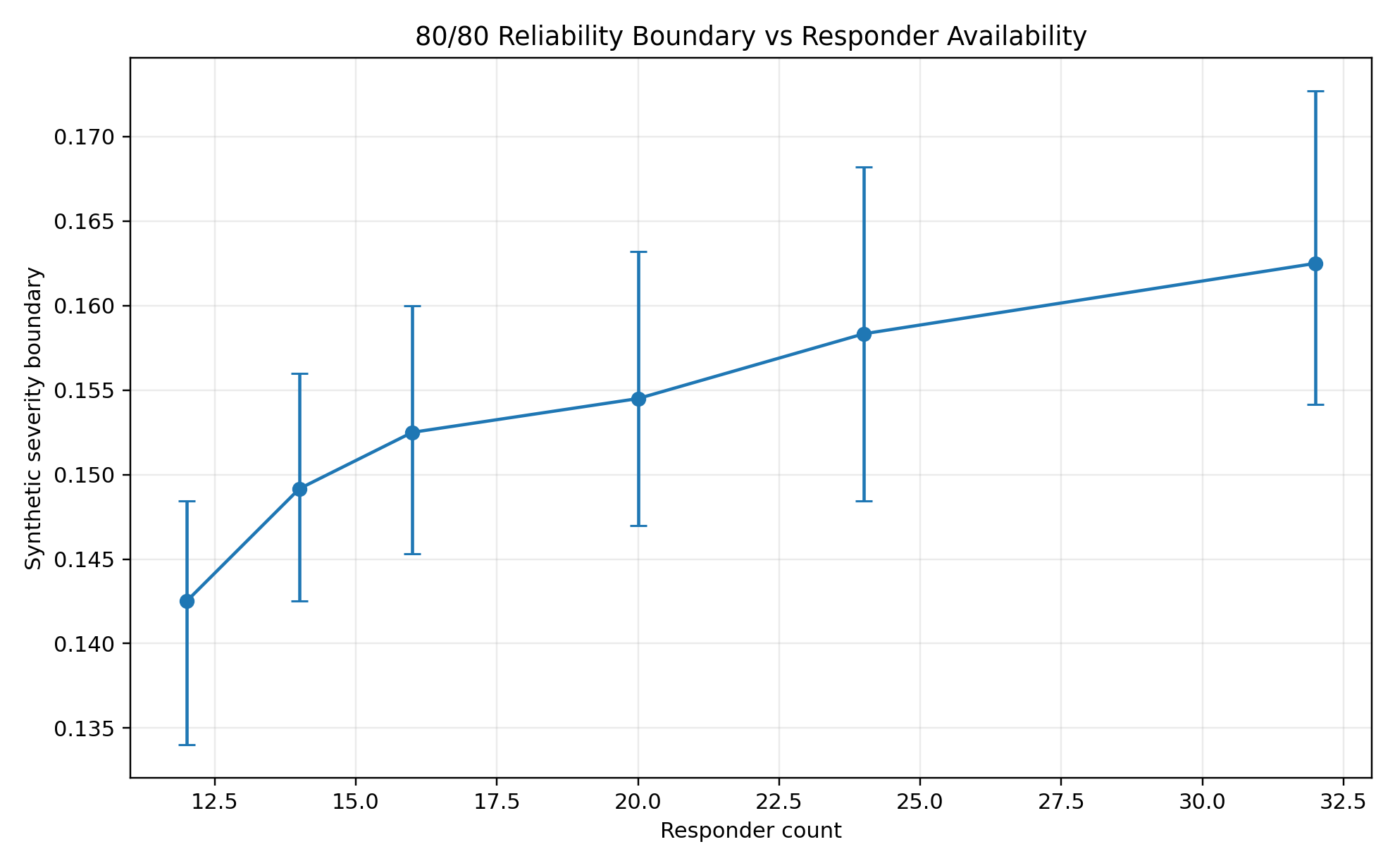
Estimate the 80/80 service-reliability boundary with uncertainty.
DATA AND PROVENANCE
Public earthquake catalogue access and normalization.
Road-network geometry and emergency-facility context.
Frozen evidence is accompanied by integrity hashes.
SYSTEM ARCHITECTURE
METHODS
The same stochastic world is progressively stressed across severity.
Greedy and Global Minimum-Cost Assignment are compared on identical scenarios.
EXPERIMENTAL DESIGN
Repeated-world inference and corrected paired comparisons.
Severity-resource grids expose a transition region.
Fine-grid confirmation closes the final boundary.
FROZEN V1.0.0 RESULTS
| Responders | Boundary estimate | 95% world-bootstrap interval |
|---|---|---|
| 12 | 0.142500 | 0.134000–0.148462 |
| 14 | 0.149167 | 0.142500–0.156000 |
| 16 | 0.152500 | 0.145333–0.160000 |
| 20 | 0.154500 | 0.147000–0.163214 |
| 24 | 0.158333 | 0.148462–0.168214 |
| 32 | 0.162500 | 0.154167–0.172727 |
80/80 boundary at 12 responders
80/80 boundary at 32 responders
Confirmatory cells significant after Holm correction
REPRODUCIBILITY
The final evidence is traceable to two frozen GitHub Actions runs.
v1.0.0
10.5281/zenodo.21903851
Concept DOI for all versions
10.5281/zenodo.21903850
REPOSITORY MAP
app/Interactive Streamlit research interfacesrc/turkiye_disaster_twin/Data, simulation and research softwarescripts/Reproducible benchmark entry pointstests/Automated regression and method testsresults/Frozen research evidence and checksumsdocs/Public GitHub Pages presentation.github/workflows/CI and research benchmark automationLIMITATIONS AND RESPONSIBLE USE
The results demonstrate a reproducible computational method rather than validated operational performance.
CITATION

AUTHOR
Author · Software Engineer · AI Researcher
Faramarz Kowsari is based in İstanbul and develops open research software and technical research systems.