Visual Engineering Book · Open-Source Research Software

AI APIs
in Practice

A complete visual book and executable open-source engineering project for multimodal AI, agents, RAG, evaluation, governance, safety, and production-ready applications—created by Faramarz Kowsari.

AI APIs in Practice

The official visual book associated with the executable AI API Playbook software project.

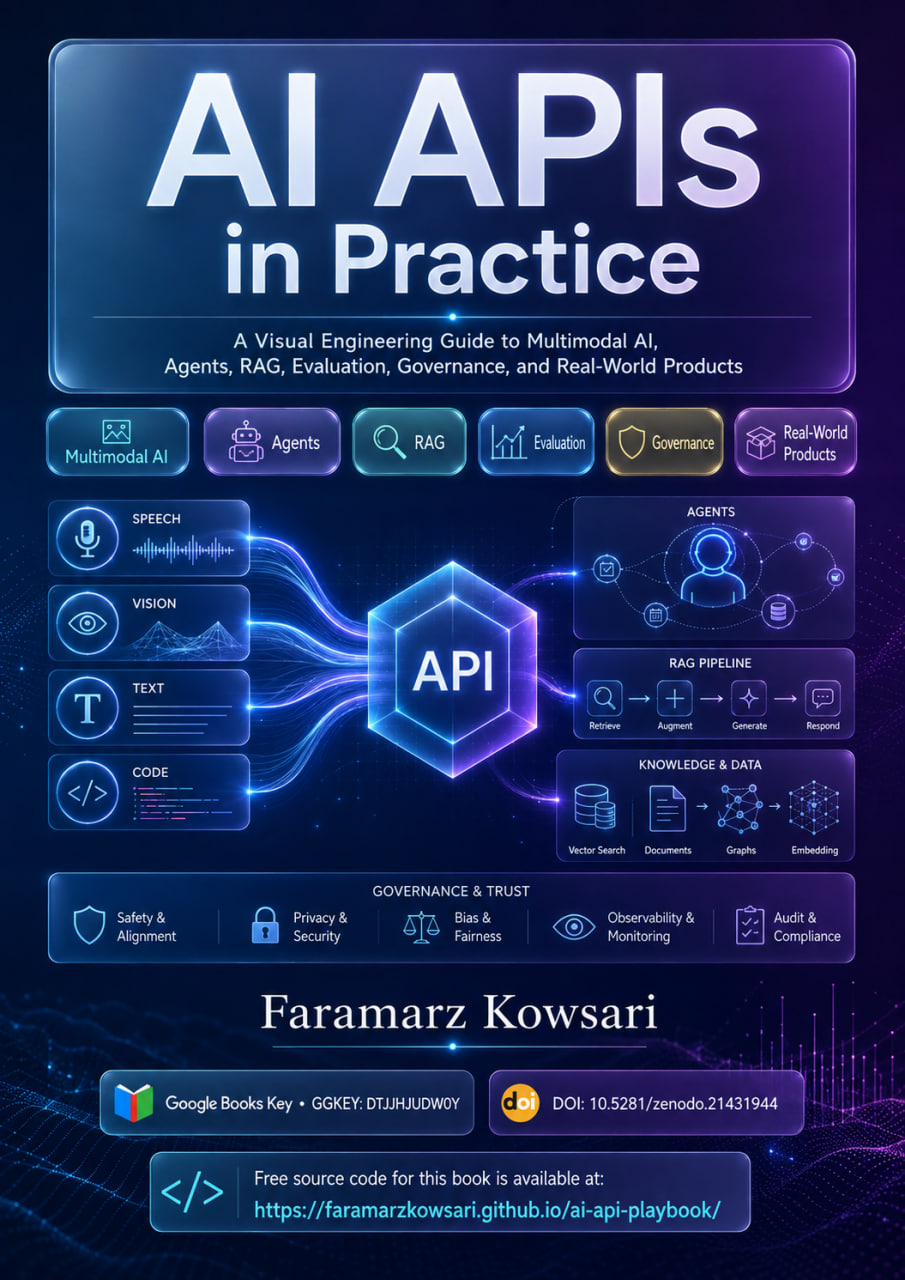
Cover of AI APIs in Practice by Faramarz Kowsari

Engineering Modern Intelligence Through APIs

A Visual Engineering Guide to Multimodal AI, Agents, RAG, Evaluation, Governance, and Real-World Products

This visual technical book explains how modern AI capabilities become reliable systems. It connects API architecture, structured outputs, tool use, agents, retrieval-augmented generation, multimodal computing, evaluation, governance, security, observability, cost control, and commercially useful products.

The publication moves beyond isolated prompts and demonstrations. It provides a production-oriented map for designing, evaluating, securing, governing, and commercializing AI systems across text, documents, images, audio, speech, realtime interaction, and video.

92 Pages Version 1.0 First Edition English CC BY 4.0 DOI: 10.5281/zenodo.21431944

From API foundations to production systems

The book and repository are organized around durable engineering capabilities rather than short-lived model names, making the project useful for learning, experimentation, architecture design, research, and commercial prototyping.

01

Language and reasoning

Prompting, structured outputs, schema validation, reasoning workflows, and code generation.

02

Agents and tools

Function calling, tool use, agent orchestration, computer interaction, search, and MCP patterns.

03

RAG and knowledge

Embeddings, chunking, vector stores, hybrid retrieval, reranking, citations, and grounded evaluation.

04

Multimodal AI

Vision, OCR, image generation, speech, realtime voice, video, and media pipelines.

05

Production engineering

Security, privacy, retries, observability, caching, routing, budgets, and cost controls.

06

Evaluation and governance

Quality measurement, human approval, safety controls, auditability, evidence, and operational policy.

07

Commercial blueprints

Product concepts based on measurable outcomes, unit economics, safeguards, and customer value.

08

Document intelligence

PDF understanding, OCR, layout-aware extraction, structured data, page references, and verification.

09

API architecture

REST, SSE, WebSocket, WebRTC, webhooks, asynchronous jobs, batch processing, and resilience.

Book, code, documentation, and citation

Move from the visual framework to runnable examples, architecture guidance, provider coverage, preserved research records, and machine-readable citation metadata.

One project, two independent citations

The book and software are published separately so readers can cite the visual publication, the executable implementation, or both.

AI APIs in Practice

Visual engineering framework, educational architecture, diagrams, production patterns, and real-world product thinking.

10.5281/zenodo.21431944
CC BY 4.0 Version 1.0 92 Pages

AI API Playbook

Executable examples, provider-neutral abstractions, tests, notebooks, safety utilities, evaluation workflows, and product blueprints.

10.5281/zenodo.21419466
MIT License Version 1.0.0 Python 3.11+
Faramarz Kowsari, author, Software Engineer and AI researcher based in Istanbul

About Faramarz Kowsari

Faramarz Kowsari is an author, Software Engineer and AI researcher based in Istanbul. His work connects Artificial Intelligence, software architecture, data science, technical education, visual knowledge design, and open-source development.

He is the author of AI APIs in Practice, a visual engineering guide to multimodal AI, intelligent agents, retrieval-augmented generation, evaluation, governance, security, observability, and production-ready AI products. The book is independently archived and citable through DOI 10.5281/zenodo.21431944 and is also available through Google Books.

He also designed and developed the companion AI API Playbook, an open-source research-software project containing executable examples, provider-neutral abstractions, tests, notebooks, safety utilities, evaluation workflows, and commercial product blueprints. The software has its own permanent record: DOI 10.5281/zenodo.21419466.

Across more than 80 digital titles published on international platforms, his broader areas of work include prompt engineering, algorithmic trading, educational technology, classical literature, mindfulness, web-based learning tools, and specialized instructional media.

Artificial Intelligence AI APIs Prompt Engineering Software Engineering Data Science AI Evaluation AI Governance Educational Technology

Official Profiles and Repositories